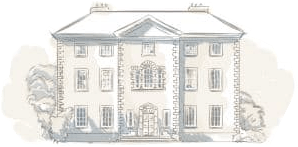


Most old houses in Ireland have a story. Roundwood has several, and they span three centuries, a Quaker merchant, a rock album, Francis Bacon’s muse, and a family who decided to open their doors and keep the place going. It’s the kind of history that reveals itself gradually, in the details of the rooms and the books on the shelves, rather than all at once.
If you’re thinking ofcoming to stay, knowing a little of the background adds something to the visit. And if you’re the kind of person who finds old houses interesting for their own sake, this one has plenty to hold your attention.
Friendstown: The Quaker Beginnings
The story of Roundwood begins not with the house itself but with the land, and with a man named Anthony Sharp. In around 1685, Sharp, a Dublin wool merchant and Quaker, purchased the property then known as Killinure and established a small community here that he named Friendstown. The name was a nod to the Quaker tradition of referring to fellow believers as Friends.
Sharp was by all accounts a remarkable figure. He ran large flocks of sheep on the land to supply wool to his workshops in Dublin, and his business eventually employed 500 people of different religious backgrounds at a time when such mixing was unusual and often actively discouraged. His Quaker principles, particularly the belief in treating everyone equally in business as in life, seem to have been genuinely held rather than merely professed. He became an alderman of Dublin and accumulated significant property in both Ireland and England. In North America he made a speculative purchase of a share in what are now parts of New Jersey, and his son Isaac is recorded as having lived there for a time in the 1720s.
The Georgian house that stands today was built by Isaac’s eldest son, Anthony Sharp, named after his grandfather. The name Roundwood appears for the first time in registered deeds in 1741, replacing the older name of Killinure. The house dates from that period and has changed relatively little in its essential form since.
Two Centuries of Changing Hands
Anthony Sharp lived at Roundwood until his death in 1781. The property then passed to his grandson Robert Anthony Flood, who took the name Sharp in accordance with his grandfather’s will. He was, by the available evidence, not a careful man with money. He mortgaged the Sharp properties in Dublin in 1784, and when he died in 1803 his one year old son William inherited a house already burdened with debt.
Over the following three decades the debts accumulated. By 1835 the house and its 1,680 acres were assigned to a Dublin attorney to cover what was owed, and William Flood Sharp and his wife left for England. The Sharp connection to Roundwood, which had lasted 150 years, was over.
By 1837 a cousin, William Hamilton, had bought the property, and the Hamiltons remained at Roundwood until 1968, when the house was sold to the Irish Land Commission. At that point it was boarded up and left empty, and it might easily have stayed that way.
Rescued by the Irish Georgian Society
What happened next is the reason Roundwood is still standing in its current form. The Irish Georgian Society, alerted to the situation by its chairman Desmond Guinness, bought the house and its surrounding ten acres in 1970. One of the Society’s most committed members, Brian Molloy, took on the work of bringing it back to life. The house was fully replumbed and rewired, bathrooms were installed in the 18th century closets on the upper floor, and Roundwood opened officially as a guest house on 6th June 1971.
In 1974 an American supporter of the Society, John L. Tormey of Akron, Ohio, bought the house from them. Brian Molloy continued living there and managing it, and Roundwood became a base for Irish Georgian Society volunteers working on the restoration of Damer House in Roscrea, County Tipperary. When Brian Molloy died in 1978, Tormey donated the house back to the Society.
It’s worth pausing on that sequence of events. A house that was boarded up and on the verge of being lost was saved by a combination of an architectural preservation society, a single dedicated individual, and an American donor who gave it back when he no longer needed it. That kind of thing doesn’t happen very often, and without any one of those people Roundwood would most likely not be here.
Francis Bacon, Marianne Faithfull, and a Rock Album
In the late 1970s and early 1980s, Roundwood attracted a notably bohemian set of visitors. Henrietta Moraes, one of the great muses of postwar Soho, lived at the house during this period. She had been painted repeatedly by Lucien Freud and Francis Bacon, and her portrait by Bacon sold at auction in 2012 for 21 million dollars. She was a close friend of Marianne Faithfull, who was living in Ireland at the time, and the house drew in others from that circle.
In May 1978, rock musician Eric Burdon, formerly of The Animals, recorded his album Darkness, Darkness at Roundwood. It’s an unlikely detail for a Georgian country house in County Laois, but that was the kind of place it was during those years: somewhere people came to work, to recover, and to be left alone in good surroundings.
The Kennans, and Then the Flynns
Frank and Rosemarie Kennan leased Roundwood from the Irish Georgian Society in 1983 and opened it as a family home guest house. They bought the property from the Society in 1988. Over the following decades they restored and furnished it carefully, building upFrank’s Library to over 2,000 books and running the house in a way that kept it feeling like a home rather than a business.
The house is now run by Hannah Flynn, Frank and Rosemarie’s daughter, and her husband Paddy, who cooks. They have continued the same approach: guests are welcomed into a house that is still lived in and used as it was meant to be. The fire is lit in the drawing room when people arrive.Dinner is cooked fresh each evening using local ingredients and produce from the kitchen garden. The library is there to be used.
What Hannah and Paddy have resisted is the drift toward hotel conventions that catches a lot of houses like this eventually. Roundwood is not a hotel and doesn’t try to be one. It’s a home with rooms, and the difference is noticeable from the moment you arrive.
If any of this makes you curious about the place in person, you’re welcome to come and see it for yourself. You canbook a room here or have a look at thecottages in the grounds if you’d prefer more independence. If you have questions,get in touch or call +353 57 873 2120.
The House Today
Roundwood is an 18th century Palladian villa, and the architecture historian Maurice Craig described it as one of the finest mid size houses of the Georgian period in Ireland. The proportions are good, the setting in its 18 acres of woodland and meadow is calm, and the rooms have the kind of depth that comes from three centuries of continuous habitation rather than a single period of decoration.
Guests who are interested in the history of the house will find plenty to look at and ask about. The rooms contain original paintings, period furniture, and books that reflect the various people who have lived here. Theperimeter walk around the grounds passes the old outbuildings and a flax mill, which are remnants of the estate’s working past. And if you sit in the drawing room long enough, Paddy will usually tell you more than is written here.
Some houses wear their history lightly. Roundwood is one of them, and that’s part of what makes it a good place to spend a few days.
FACEBOOK | TWITTER | INSTAGRAM | LINKEDIN
